Photonic PCBs are a new type of printed circuit board that can efficiently transfer data at tremendously high speeds without losses. 5G telecommunications, HPC, AI hardware, computers, and data centers are all rapidly advancing and creating an increasing demand for more effective data transmission at ever-higher speeds and signal integrity. Traditional printed circuit boards are limited by their physical characteristics and are unable to stand up to these challenges. That is where photonic PCBs are coming in. They use light in place of electricity for transmitting data. Now this revolutionary alternative is leading to the question, whether photonic PCBs are the future of optical interconnects? In this article, we, at PCB Trace Technologies Inc., will endeavor to answer this question.
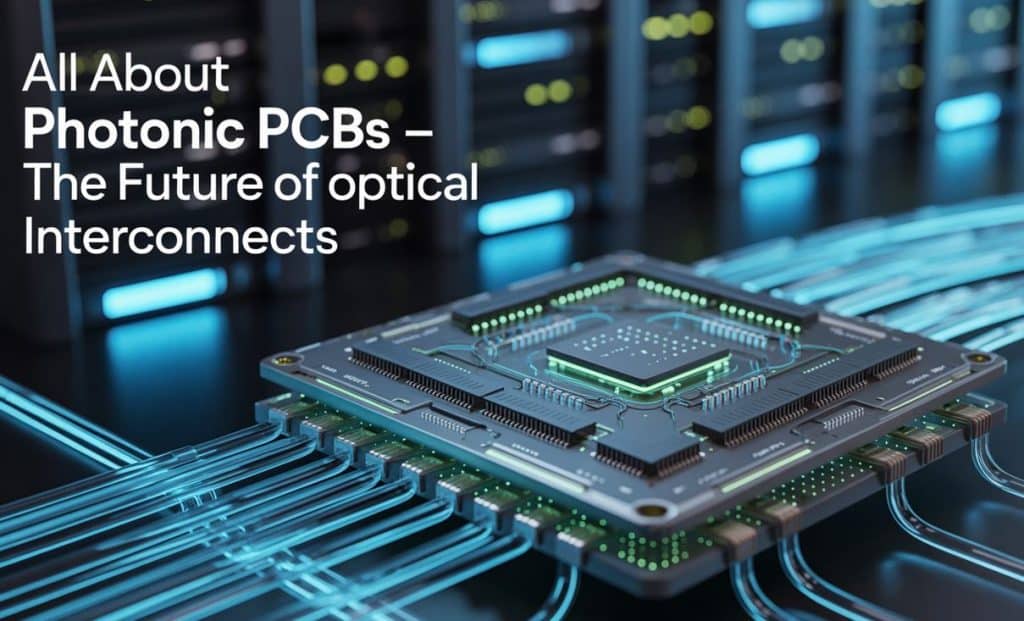
What are Photonic PCBs?
Definition
Photonic PCBs use optical interconnects to transfer data. Rather than using electrical signals to transfer data as in regular PCBs, photonic PCBs move data as light pulses. Moreover, in place of using copper conductors as waveguides, the light pulses in photonic PCBs pass through waveguides made of polymers or silicon nitride dielectric materials.
Why Optical Waveguides?
Electrical signals suffer resistive losses as they travel through a copper medium. They are also subject to electromagnetic interference (EMI). Optical signals, on the other hand, are not subject to resistive losses or EMI. Therefore, with optical signals, it is possible to achieve much higher bandwidths and much longer transfer distances without facing signal degradation. Moreover, these optical wave guides can be directly integrated into PCB substrates.
Key Components of Photonic PCBs
Some key components include:
- Light Sources: Typically, laser diodes for light generation
- Optical Waveguides: Thin transparent structures to guide the light signals
- Modulators: Devices for encoding data onto the light signals
- Photo-Detectors: Devices for converting light signals into electrical signals
- Couplers and Splitters: Devices for directing and distributing optical signals
How Do Photonic Interconnects Work?
Optical Vs. Electrical Interconnects
Electrical interconnects or regular PCBs transfer data as electrical signals using copper traces as the conducting medium. For high-speed signal transmissions, they use waveguides made of copper traces and planes, separated by dielectrics, arranged in specific geometries. To maintain signal integrity, it is necessary to use special low-loss dielectric substrates.
On the other hand, optical PCBs use light pulses to transfer data. They use optical waveguides made of special materials like polymers or silicon nitride. These are thin transparent structures integrated within the PCB substrate that guide the light signals.
Advantages of Optical Signal Transmission
Light-based signal transfer has several advantages over electrical signal transfer. These include:
- Higher Speed and Bandwidth: While electrical signal transfer can at best go up to megabits to gigabits per second or Gpbs, light-based signal transfer can go up to terabits per second or Tbps. This is about 1000 times faster. Moreover, light-based signal transfer is not limited by skin effect and crosstalk.
- Low Power Consumption: To maintain signal integrity over long distances, electrical interconnects need to expend significant power. On the other hand, photonic integrated circuits, owing to their low attenuation and loss, require much less power to transfer data.
- Reduced EMI or Electromagnetic Interference: While electromagnetic fields affect electrical signals, they do not interfere with optical signals. This makes photonic PCBs impervious to EMI issues and eminently suitable for high-speed transmissions and high-frequency systems.
- Lower Latency: The resistive nature of electron flow in copper introduces propagation delays. This is a problem in HPC, or high-performance computing. Light, traveling at much higher speeds, does not slow down, and consequently, has much lower latency problems.
- Scalability & Miniaturization: Physical copper traces can be reduced only up to a certain scale before they start exhibiting higher resistance and skin effect at high frequencies. This problem does not exist for photonic integrated circuits, and hence they can be fabricated at micrometer scales. This allows more compact PCB designs with denser interconnects.
Benefits of Photonic PCBs
1. Ultra-high Data Transfer Rates
Not limited by skin effect, crosstalk, resistance, or EMI, photonic PCBs can boast of ultra-high data transfer rates reaching Tbps or terabits per second. This is at least 1000 times better than the highest speed that electrical interconnects have achieved.
2. Low Power Usage
To maintain signal integrity for high-speed/high-frequency signals at long distances, electrical signals must expend a large amount of energy. This is to overcome the losses, attenuation, and heat en route. As optical signals do not suffer from such issues, they can operate with a much lower power input.
3. Heat Reduction
Electrical losses lead to the generation of heat. To overcome the electrical losses, it is necessary to use a higher power input. Since photonic PCBs do not suffer such losses, they need much lower power inputs. This leads to a substantial reduction of heat generation in photonic PCBs.
4. Immunity to EMI or Electromagnetic Interference
One of the biggest challenges of regular PCBs is their compatibility with EMI. There are two aspects to this issue. External electromagnetic interference can affect the functioning of a regular PCB. Similarly, a regular PCB can generate EMI to influence neighboring electronics. OEMs typically spend a fortune on preventing both situations.
5. Optical Interconnects
using light signals, are immune to electromagnetic influences. Hence, they are neither affected by external EMI signals nor do they generate anything that can disturb other interconnects nearby.
Challenges and Limitations of Photonic Interconnects
1. Fabrication Complexities
Manufacturing photonic integrated circuits involves surmounting fabrication complexities like the extreme precision necessary during alignment of optical components and waveguides. In addition, variations in silicon thicknesses caused by etching inconsistencies may cause wavelength mismatches. This can also be due to varying compatibility when integrating diverse materials. Manufacturing complications can also arise from 3D structuring, intricate active alignment, and high-resolution lithography.
2. Cost of Integration
Increase in manufacturing complexities and the resulting rise in expenses may be attributed to material limitations, heterogeneous fabrication processes, and packaging. For instance, PCBs with optical layers may need integration with CMOS electronics, where it is necessary to bond different materials along with wafer-scale alignment. Although integration reduces the total number of discrete components and assembly steps required, one must tradeoff between heterogeneous and monolithic approaches. As initial design costs and production expenses are high, large volumes are necessary to achieve economies of scale.
3. Limited Industry Adoption and Standards
At present, limited industry adoption of PCBs with optical layers is mainly due to high costs, complex manufacturing processes, and the need for precise integration with electronics. Standards are still evolving for connector types, loss measurements, and reliability issues. These are limiting the widespread use of optical PCBs. For broader adoption, standardized manufacturing processes must evolve, and there must be greater automation and maturity of the ecosystem.
4. Design Tool Limitations
Present design tool limitations related to optical interconnects include challenges in modeling large-scale circuits that contain multiple interconnected photonic components. There are limitations in accurately capturing optical effects like parasitic reflections. In addition, one must also account for variations during fabrication through accurate simulation frameworks, such that these issues can be predicted and mitigated. Most importantly, there are no standardized tools that can accurately assess the efforts of packaging, testing, and automated assembly. These limitations complicate the integration processes and reliability assessments.
Applications & Use Cases for Photonic Interconnects
1. Data Centers and Cloud Computing
Data centers and cloud computers benefit from optical waveguide PCBs, as they can move data much faster. With photonic integrated circuits linking servers, there is a lowering in energy use, with a substantial boost to the bandwidth. This helps to reduce heat and latency or delay. The advantage to the user is faster web searches, video streaming, and cloud storage. As a result, there is a substantial increase in machine learning workload speeds and performance of large-scale artificial intelligence entities.
2. 5G Infrastructure
High-speed data movement using optical interconnects helps connect 5G antennas to core networks with substantially lower delays. As a result, the system can handle large amounts of data easily, while saving energy as compared to electronics. This benefit to 5G systems translates to smooth streaming, gaming, and smarter industry automation.
3. High-Performance Computing (HPC)
The fast, energy-efficient data transfer using optical interconnects helps high-performance computing by reducing the latency and increasing the bandwidth between processors, memory, and storage systems. This helps HPC to support AI, big data, and high-speed signal transmission simulations. With co-packaged optics and optical interconnects in chip-to-chip and board-to-board links, HPC systems can substantially improve their efficiency and communication capabilities.
4. Aerospace & Military Systems
With optical PCBs, aerospace and military systems gain the benefits of fast, secure communications and sensing. This helps to reduce the weight, size, power, and heat in aircraft and satellites. Aerospace and military systems use PCBs with optical layers in advanced defense system applications like LIDAR, RADAR, electronic warfare, antenna beamforming, high-speed data links, and optical computing.
Current Market Trends & Future Outlook for Photonic Interconnects
Who is Leading the Development?
There are many giants and startups in the development of optical PCBs. Intel and IBM are focusing heavily on silicon photonics and optical waveguide PCBs. Startups like Ayar Labs are aggressively advancing optical interconnects, and they have a lineup of investors like Intel Capital and AMD Ventures.
What is the Expected Growth in Adoption?
The insatiable demand for high-speed signal transmission is causing photonic interconnects to grow rapidly. While it is expected to grow at 20-29% CAGR, it can reach USD25-97 billion between 2030 and 2034. At present, silicon photonics is leading in adoption because of its energy efficiency and scalability.
Will Photonic Interconnects Replace Copper Entirely or Remain Niche?
It is difficult for PCBs with optical layers to replace copper entirely any time soon. Although the benefits of photonic interconnects far outweigh copper in terms of bandwidth and long-distance signal integrity, the former is still a complex technology for the mass consumer and chip packaging use. Photonic interconnects will, therefore, coexist as a niche technology, gradually expanding into mainstream environments.
Conclusion
Compared to traditional copper-based PCBs, optical waveguide PCBs are a transformative shift. They offer high-speed signal transmission, unparalleled bandwidth, reliability, and energy efficiency compared to regular PCBs. Although challenges remain in integrating photonic interconnects and their cost, advances in materials science and fabrication are pushing their adoption across industries.
As long as the demand continues to grow for faster and more effective computing, photonic PCBs will take over as the backbone for the next-gen communication and processing systems.
At PCB Trace Technologies Inc., we recognize continued R&D in silicon photonics, quantum photonics, and plasmonics is the key to overcoming the present hurdles facing optical interconnects. In the future, expect to see fully optical computing replacing electronic components altogether, quantum communication through quantum photonic PCBs, and self-healing waveguides that can repair their optical pathways automatically.