Confused about which PCB substrates to use? Learn how choosing the right material can boost your board’s performance, reliability, and application compatibility.
Introduction to PCB Substrate Materials
By definition, a substrate is a fundamental material necessary for the fabrication of a rigid printed circuit board.
Importance of Substrates in Performance and Reliability of PCBs
Apart from providing the necessary rigidity to a PCB, the substrate also offers structural support to the additional layers in the board and the electronic components mounted on the board’s surface.
Both rigid and flexible substrates are important components in the respective types of PCBs. Their presence allows accurate mounting of electronic components for densely populated boards. By helping to absorb external mechanical vibrations, the substrates allow the board to function mechanically and electrically as intended, thereby increasing its reliability and longevity.
Reliable Partner — PCB Trace Technologies Inc.
If you are looking for a reliable partner for manufacturing your PCBs, you have come to the right place. PCB Trace Technologies Inc. is one of the leading manufacturers of PCBs with the most reliable multilayer PCB substrate materials.
What is a PCB Substrate?
PCB substrate materials are the vertebrae of a printed circuit board. In rigid PCBs, they are stiff materials, providing the board with its rigidity and structural support.
Role of the Substrate in PCBs
1. Function:
Functionally, multilayer PCB substrates provide the necessary structural support for building up the stack. Typically, a multilayered PCB has its layers equally distributed on either side of the substrate. Other names for the substrate are core or base material.
2. Mechanical Support:
The PCB substrate offers mechanical support to the structures surrounding it. These are the layers, traces, vias, and pads that form the interconnections between the layers and components on the board.
3. Electrical Insulation:
The substrate also provides the much-needed insulation between the two layers immediately surrounding it. Its high dielectric strength prevents electrical shorts between traces and components. It also helps in maintaining signal integrity and preventing crosstalk and electrical interference.
Comparison of Substrate Types
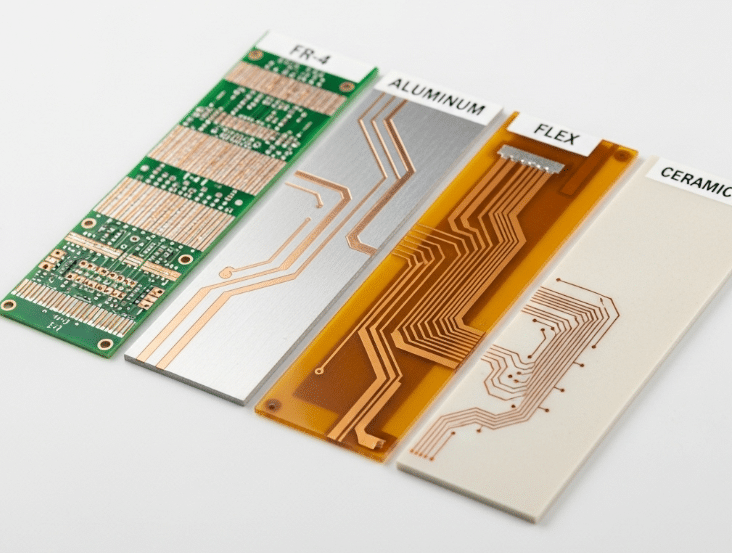
Depending on the materials making up the board, the PCB substrate can be of a variety of types. Some of the more common types are:
- FR4: FR4 substrate is the most versatile and popular substrate material for PCBs. Its composition is epoxy resin binding woven glass fabric acting as reinforcement.
- Ceramic: Ceramic PCB substrates are composed of aluminum nitride or alumina. Ceramic PCB substrates offer excellent mechanical stability and high thermal conductivity.
- Rogers: Rogers PCB substrates are Teflon-based. These low dielectric PCB substrates are specifically designed to be low-loss PCB substrates for high-frequency applications.
- Polyimide: Not all boards are rigid. For flexible boards, the substrate must also be flexible, and Polyimide offers the necessary characteristics along with flexibility.

Types of PCB Substrate Materials
| Substrate Type | Tg (°C) | Dk | Df | CTE (ppm/°C) | TC (W/m/K) |
| FR4 | 130-140 | 4.2-4.8 | 0.02-0.025 | 12-20 | 0.3 |
| Ceramic | 240-280 | 2.1 | 0.0001 | 7 | 24 |
| Rogers | >280 | 2.5-2.8 | 0.0037 | 17-30 | 0.3-0.6 |
| Polyimide | >250 | 3.4 | 0.008 | 20 | 0.12 |
The above table lists some important characteristics of rigid and flexible substrate materials. Based on these characteristics, we can summarize the following:
- FR4 substrates offer an average performance, good for general-purpose applications, are affordable, and versatile. They are not suitable for high-temperature soldering, as required by lead-free solder. The thermal conductivity of PCBs with FR4 substrates is on the low side.
- Ceramic PCB substrates offer very good performance at high temperatures. With excellent thermal conductivity, these substrates are most suitable for high-power circuits. Ceramic substrates are good for high-frequency and high-speed signals because of the low dielectric constant of PCB. They offer stable electrical performance over a wide range of temperatures and frequencies.
- Rogers PCB substrates are also eminently suitable for high-temperature applications, as they have a high glass transition temperature. Although these high-frequency PCB substrates are good for RF and microwave applications, the user must choose a suitable variant if looking for a high thermal conductivity PCB.
- Polyimide substrates are good for flexible PCBs operating at high temperatures. They offer good high-speed and high-frequency performance.
Right PCB Substrate Selection for PCBs
When choosing the right PCB substrate or the PCB base material, one must consider the thermal, electrical, and mechanical performance of the material. One must look for:
Thermal Characteristics
- High breakdown voltage
- Low leakage currents
- Low signal attenuation
- Wide frequency range
- High signal speed handling
- High signal integrity
- Good power handling capacity
- High Q-factor
Mechanical Characteristics
- Good flexural strength
- High tensile strength
- Good impact resistance
- High stiffness
- High abrasion resistance
- High chemical resistance
Physical Attributes
- High thermal conductivity
- High glass transition temperature
- Low coefficient of thermal expansion
- High resistance to thermal cycling
- Ability to withstand thermal shocks
Electrical Characteristics
- Low flammability
- Low moisture absorption
- Low outgassing properties
Manufacturing Factors
- Easy availability
- Short lead times
- Low cost
Use Cases:
The choice of the PCB substrate materials also depends to a large extent on the use cases. For instance, industries like automotive, aerospace, medical devices, and RF applications require PCB substrate materials that possess some common but specific characteristics:
- Automotive Applications mainly require lead-free soldering capability, high flame resistance rating, and the capability to withstand high temperatures under the hood. The most suitable substrate material is FR4 with a high Tg resin system capable of withstanding temperatures above 170 °C.
- Aerospace Applications require PCBs to operate with high stability at very wide temperature ranges. They must be non-gassing and capable of withstanding high amounts of vibration and shock. The most suitable substrate material is Polyimide.
- Medical Devices require highly reliable and safe PCBs, as they will be in contact with humans. They must be low-leakage type, with very low moisture absorption capabilities, and highly stable. The most suitable substrate material for medical devices is Rogers.
- RF Applications mostly use high frequencies and high-speed signals. These high-frequency PCB substrates offer very low electrical losses and very high signal integrity. For such applications, the ceramic substrates are the most suitable.
Our PCB Substrate Manufacturing Capabilities
At PCB Trace Technologies Inc., we offer all types of substrate materials. Starting from paper-based substrates to low dielectric constant PCB substrates and flexible Polyimide substrates, we supply high Tg PCB substrates like ceramic and Rogers. Our popular FR-4 substrates are cost-effective and offer high mechanical strength at 140 °C.
The laminate materials that we use to produce the substrates are suitable for multilayered HDI PCBs. These boards offer very smooth surfaces with excellent bonding for copper. This is essential for thin and closely spaced traces necessary for high-density layouts typically used in HDI circuits.
Our highly involved manufacturing techniques are capable of precision fabrication necessary for complex geometries of modern printed circuit boards. We produce flexible PCBs for smartphones that house extremely complex and high-density components.
Our manufacturing capabilities adhere to strict international quality standards. We comply with standards like:
- IPC or Institute of Printed Circuits
This association develops standards for every stage of PCB life, covering design to manufacturing, and assembly. For instance, their PCB acceptability standards are IPC-A-600, and their quality and reliability standards are the IPC 6000 series.
- UL or Underwriters Laboratories
This organization develops standards for safety. Compliance with their safety testing and certification standards helps to increase confidence in the electrical performance and reliability of our products. Our products conform to their chemical, electrical, physical, and flammability tests.
- ROHS & REACH
Following the direction of Restriction of Hazardous Substances and the Registration, Evaluation, Authorization, and Restriction of Chemicals, our products do not contain any of the forbidden chemical substances.
- ISO or International Organization for Standardization
PCB Trace Technologies Inc. is certified by ISO for our quality management system ISO 9001. As per the requirements of ISO, we offer documented agreements for quality with technical criteria and guidelines. We are also certified for ISO 13485 and AS9100.
Why Choose PCB Trace as Your PCB Substrate Supplier
As your PCB substrate supplier, PCB Trace Technologies Inc. offers many outstanding services that help you reach the market quickly with high-quality products. Our state-of-the-art production facilities not only offer fast prototyping, but are also capable of high-volume quantities at short notice. We offer multilayered lamination, drilling and plating, electrical patterning, and several types of surface finishing.
With our international sourcing capabilities and trusted sources, we offer custom PCB substrates from anywhere in the world at short lead times. We can offer you a combination of materials for substrates that will match your application requirements.
As an ISO certified organization, we offer products assured of quality. Our products conform to international standards like IPC, UL, MIL, J-Std. We are equipped with the latest testing equipment for:
- AOI or Automated Optical Inspection to detect defects in copper clad
- X-Ray Inspection for checking internal layer alignment and the integrity of vias
- Electrical Testing for checking continuity and isolation.
In addition, we offer turnkey engineering solutions for covering your projects from concept to production. Our expert teams specialize in RF PCB design, high-speed digital design, and microwave electronic design. We offer exceptional turnaround times for your projects to help meet your customer deadlines.
Frequently Asked Questions
Q. What is the difference between FR4 and Rogers substrates?
A. There are two major differences between the two types of PCB base materials. The first is in the Tg or glass transition temperature of the two materials. For FR4 materials, the Tg is in the range of 130-140 °C, whereas Tg for Rogers is above 280 °C. What this means is that a high Tg PCB made of Rogers material is capable of withstanding much higher temperatures as compared to FR4, such as during soldering with lead-free solder, without damage.
The second major difference is in the Df and Dk values between the two materials. The Df and Dk values for the Rogers material are considerably lower than those for FR4. That means the Rogers material, being a low-loss PCB substrate, is more suitable for high-frequency signals, as it causes significantly lower attenuation and lower loss of signals. The Rogers material is therefore superior to FR4 for high-frequency applications.
Q. How do I choose the right substrate material?
A. We have provided the answer in the article above. Broadly, you must look for a material that has the correct stiffness or flexibility for your application. Then you must look for the frequency range of your application and select the low-loss PCB substrate material that will be the best fit. Next, look at the temperature range that your application must withstand, and select the substrate material accordingly.
Q. Can I get a custom PCB substrate solution?
A. Absolutely yes. At PCB Trace Technologies Inc., we offer our customers exclusive custom PCB substrate solutions that will meet their specifications completely. Give us your requirements today, and we will offer you an instant quote.
Are you willing to take your electronic designs a notch higher? Pick the right PCB substrate and you’ll unlock the full potential of your project. PCB Trace Technologies Inc. offers reliable and high-quality PCB substrate materials to most of the industries such as automotive, aerospace, medical, and RF industries. Discuss a special solution with our professional team. Know the feeling of accurate work and high-quality assistance which can change your business. Let us assist you to come up with your next innovation.